
Can you charge customers extra for paying by card?
Since January 2018 UK businesses can't add a fee for payment by personal debit or credit card. What the surcharge ban covers, what you can still charge for, what happens if you get it wrong, and how to cut your card costs legally instead.
No. In the UK you cannot charge a customer extra for paying with a personal debit or credit card, and that has been the law since 13 January 2018. You can still charge a fee on business (commercial) cards, but never more than the payment actually costs you.
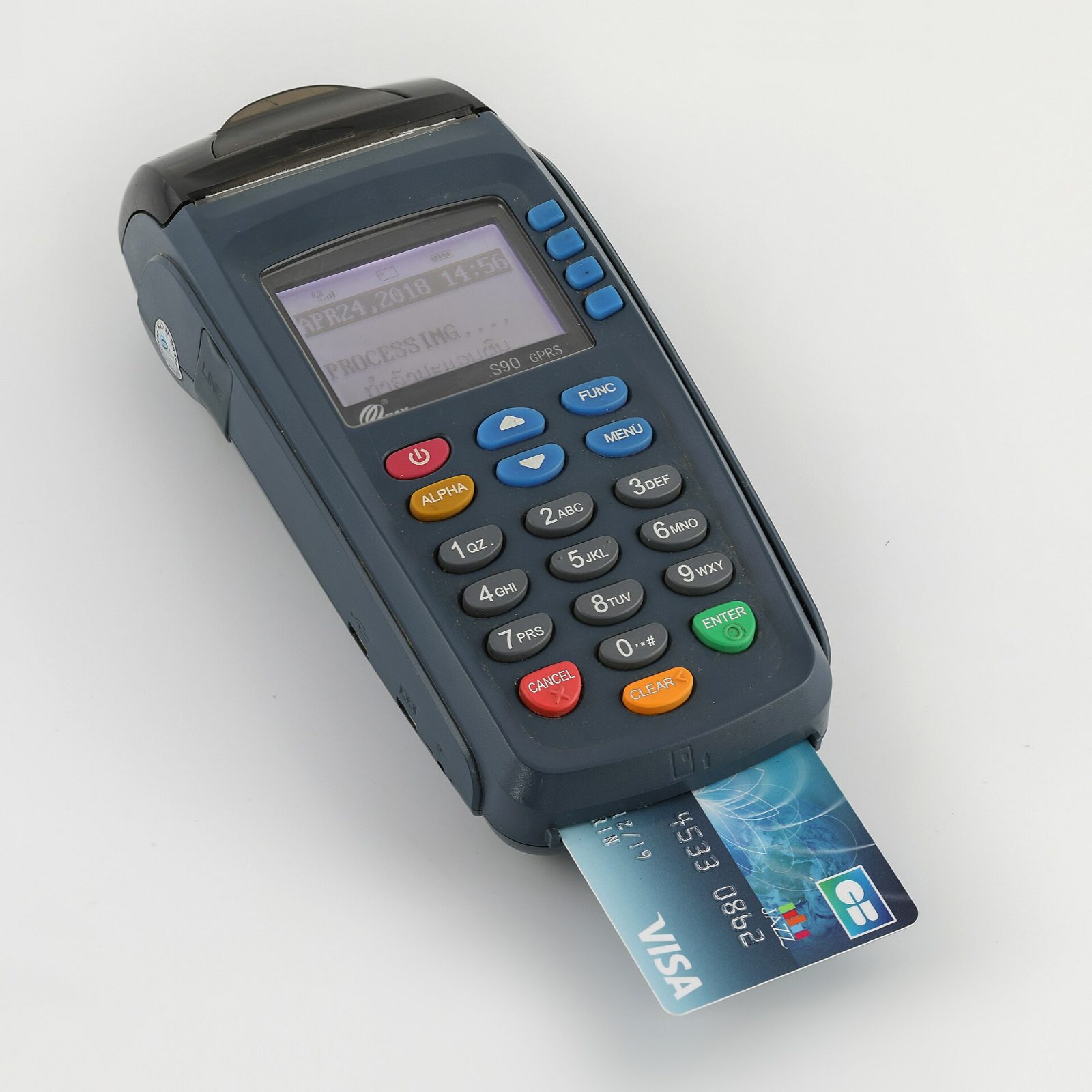
Photo: Credit card terminal in Laos by Basile Morin, CC BY-SA 4.0, via Wikimedia Commons
Card fees are a real cost, and when a supplier puts its prices up or a busy month brings a bigger statement, adding "50p for cards" can look like an easy fix. It isn't allowed for most of your customers, and getting it wrong means refunds and a possible visit from Trading Standards. This guide sets out what the rules say, what you can do instead, and how to bring the cost of taking cards down the legal way.
What does the UK surcharge ban actually say?
The rule sits in the Consumer Rights (Payment Surcharges) Regulations 2012, as changed by the Payment Services Regulations 2017. Regulation 6A says a business "must not charge a payer any fee" for payment by:
- a consumer debit, credit or charge card
- a similar payment method that isn't card-based, such as paying by phone
- euro bank transfers and Direct Debits under the EU's SEPA rules
Trading Standards guidance from the Chartered Trading Standards Institute (Business Companion) adds that the ban also covers electronic payment services such as PayPal. So tapping a phone or watch at your counter is treated the same as tapping the card itself.
Which payments can you still charge a fee on?
Business and corporate cards
The ban does not apply to commercial debit or credit cards, the cards a company gives its staff or directors. If a trade customer pays with one, you can add a surcharge.
The cost cap still applies
Even where a fee is allowed, it must not be more than the cost you bear for that payment method. There is no fixed maximum, but Business Companion advises keeping records that support your actual costs. In plain terms: the fee can cover what that card costs you to accept, and no more.
Cash and cheques
The guidance says other payment methods, such as cash, cheques, standing orders and Direct Debits, are not banned from carrying a fee, but any fee is still limited to your cost.
What happens if you get it wrong?
According to Business Companion, if a customer hasn't paid a banned fee yet, you can't make them pay it. If they have paid it, you must refund it, and they can take legal action to recover it. Local Trading Standards can investigate complaints and apply to a court to stop a business charging unlawful fees.
What this means for your business
If you run a shop, café, salon, takeaway or trade counter, the practical position is:
- Remove any blanket card fee. Check your till buttons, menus, website checkout and signs for "card fee", "contactless charge" or similar wording.
- Handle business cards separately. If you want to surcharge commercial cards, you need to be able to tell them apart and show the fee is no more than your cost. For many small businesses the extra admin isn't worth it.
- Show any lawful fee up front. Consumer law requires extra charges to be shown alongside the main price, not added at the till.
- Be careful with "cash price" and "card price" signs. Setting two prices can have the same effect as a surcharge. Take advice before you do it.
If card fees are eating into your margin, the answer is to lower what you pay, not pass it on.
How to cut what you pay for card payments instead
1. Read one month's statement line by line
Most card statements mix several charges together: a transaction rate, sometimes a separate authorisation fee per payment, terminal rental, a monthly minimum charge and a PCI compliance fee. Knowing which ones you pay is the first step. Our guide to what your card statement actually charges you walks through each line.
2. Work out your effective rate
Add up every charge on the statement and divide it by your total card takings for the month. That one percentage is the number to compare between providers. A low headline rate with high fixed fees can work out dearer than a higher rate with no extras.
3. Check your contract dates
Note when your contract ends, the notice period and any exit fee. Terminal rental agreements are sometimes separate from the processing agreement and can run for longer.
4. Compare like for like
Ask any new provider for a quote based on your real volumes and card mix, in writing, with every fee listed.
How we review a card statement (worked example)
When an owner sends us a statement for a free card fee review, this is the order we work in. No real client or figures are shown here.
- We list every charge on the statement and label each one: per-transaction, monthly fixed, or one-off.
- We total them and divide by that month's card takings to get the effective rate.
- We check how much of the bill is fixed. A business with low monthly takings is often hit hardest by minimum charges and rental, not the rate.
- We read the contract terms for the end date, notice period and exit fees, so we know what switching would actually cost.
- We compare against alternatives on the same volumes, and tell you plainly if staying where you are is the better option.
Sometimes the honest answer is that your current deal is fine. Whether you could pay less depends on your volumes, card mix and contract.
Frequently asked questions
Can I set a minimum spend for card payments?
The surcharge rules don't cover minimum spends, but your card provider's terms might. Check your merchant agreement before putting up a sign, and remember a minimum spend can put customers off as much as a fee.
Can I charge a fee if a customer pays with Apple Pay or Google Pay?
Not if it's a personal card behind it. Trading Standards guidance treats phone-based payments the same as the card itself.
Does the ban apply to sales to other businesses?
The ban follows the type of card, not who the customer is. A business customer paying with a personal debit card can't be charged a fee. A business customer paying with a commercial card can, up to your cost.
Bring your card costs down, not your customers' goodwill
If you'd like a second pair of eyes on your fees, book a free card fee review. We'll go through your statement with you and explain what each charge is. You can also look at our card machines page, or our Square POS setup service if you're thinking about changing your till system as well.
Call or WhatsApp 07777 175890.
Jos Finserv Ltd (company no. 14560046) is an independent broker. For business finance we are a credit broker, not a lender, and we may receive commission from providers. Approval and terms depend on your trading history. No obligation.
Sources
Want us to look at your own numbers?
Tell us how to reach you and we will come back with what is actually available for a business like yours. We are paid by the provider, not by you, so this costs you nothing either way.
- We read your current statement and explain it in plain terms
- No obligation, and no pressure to move if you are already well placed
- One conversation, not a sequence of calls
Prefer to work it out yourself first? Use the card fee calculator, or check whether finance is worth exploring.
